
Wild-type Paulownia refers to those which have not passed through long-term of artificial acclimation. They are mainly located in mountain areas with obvious uncultivated traits and strong capacity of natural regeneration. According to a survey undertaken by the former China National Academy of Agriculture and Forestry, there are four species of wild-type paulownia including P.albiphloea Z.H.Zhu sp.nov, P.catalpifolia Gong Tong, P.fargesii Franch and P.kawakamii Ito.
P.albiphloea Z.H.Zhu sp.nov
The main stem is straight, and the bark is grayish white and smooth before 7-8 years of life. The leaves are ovate or long ovate heart-shaped, mature leaves are thick and leathery, the upper surface is smooth and shiny, and the back is dense with long hair-like side branches, short-stalked dendritic hairs, and the inflorescence branches are longer, generally about 40 cm.
Paulownia catalpifolia Gong Tong
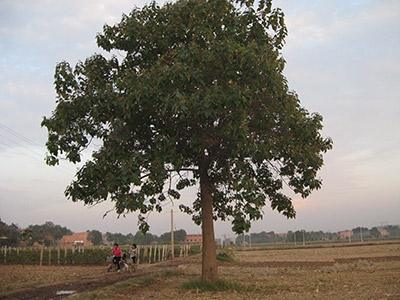
The main stem is straight and the branching angle is small. The leaves are ovate and heart-shaped, and the length is nearly twice as wide. The back is densely covered with short-stalked tree-like hairs. The inflorescence branches are conical or narrow conical.
Paulownia fargesii Franch.
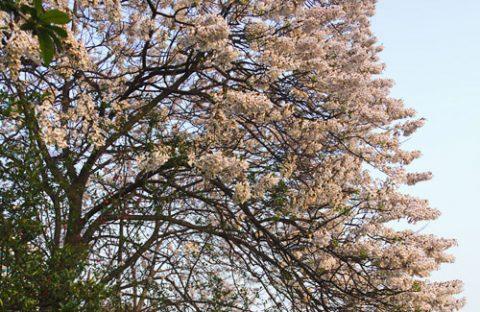
The crown is umbrella-shaped or conical, mature leaves are oval-heart-shaped, whole or microwave-shaped, and the underside of the leaves is yellow. The inflorescence branches are broad and conical, the base of the flower purple or white corolla suddenly swells into a bell shape, and the capsule is ovoid.
Paulownia kawakamii Ito
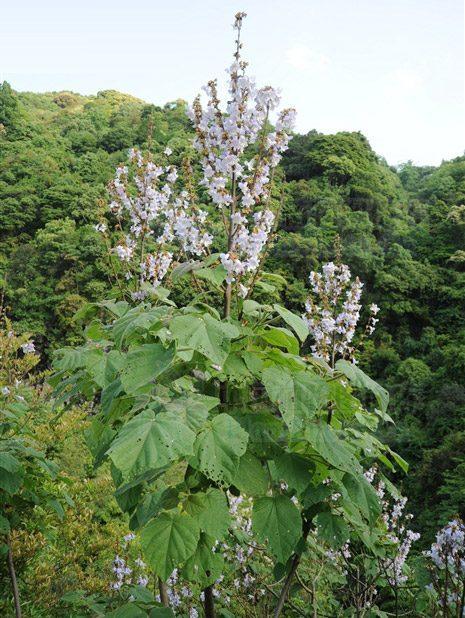
The crown is umbrella-shaped, the leaves are oval or broad-ovate-heart-shaped, the inflorescence branches are broadly conical, the cymes have no stalks, and the capsules are ovoid. The shell is thin and chitin.
Questions about paulownia cultivation? Email paulownia@vip.126.com — we reply with practical advice.